
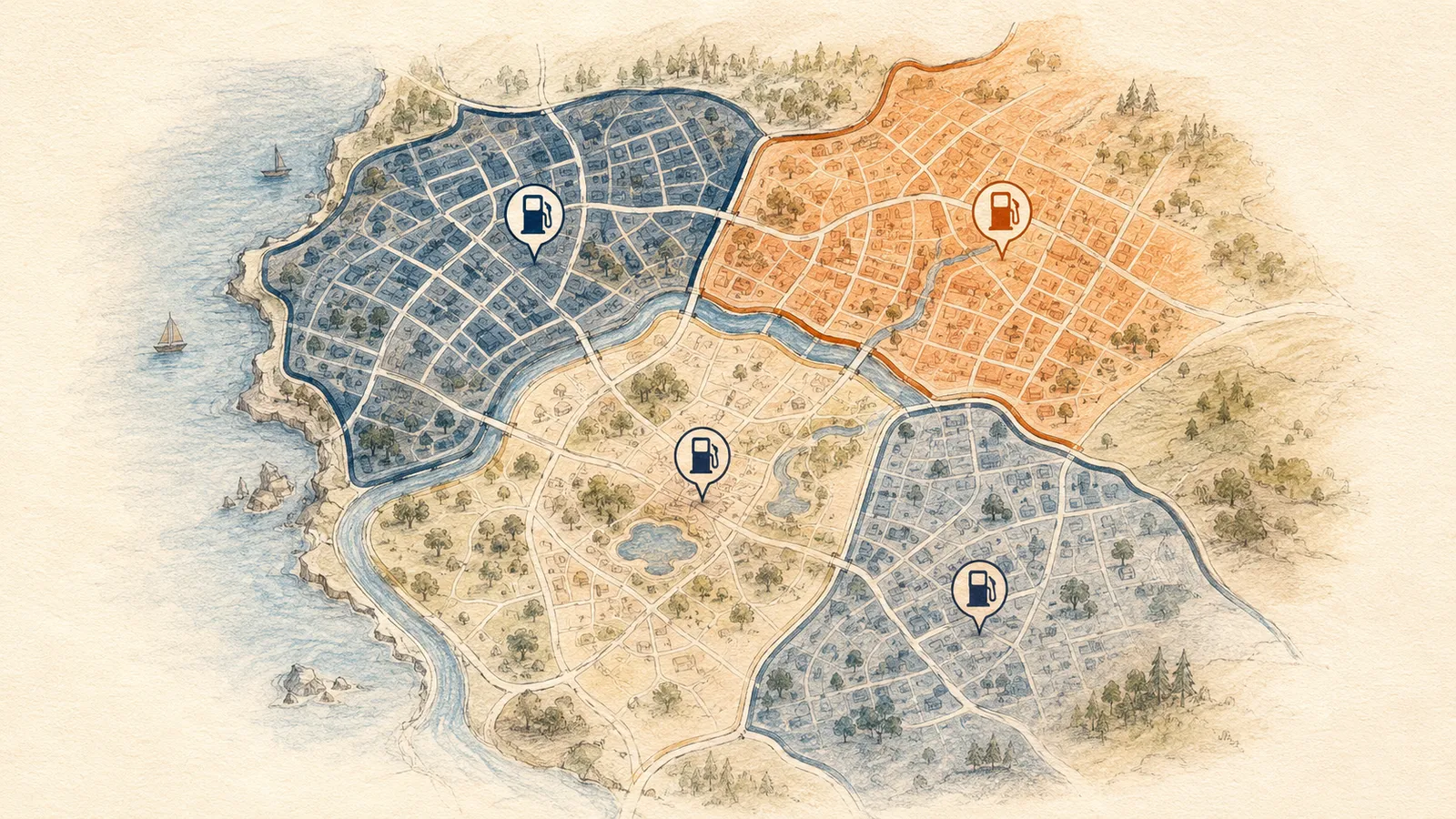
Something surprises new operators: two stations selling the same brand of fuel, a few miles apart, can pay different wholesale prices for it. That is zone pricing at work. It is a long-standing way suppliers set delivered prices by location, and it has a clear effect on your margin. This is how it works and what it means for you.
What zone pricing is
Zone pricing is when a supplier charges different wholesale prices for the same brand and grade based on where a station sits. Refiners group their retail outlets into geographic zones and set a different delivered price for each one. The fuel is identical; the price depends on the address. The spread is worth measuring: legislative studies in Connecticut and Maryland found zone-to-zone differences running from about two to ten cents per gallon, and dealers have reported wider gaps.
How it connects to DTW
Lessee dealers usually pay a delivered price, the dealer tank wagon (DTW) price. Zone pricing is how the supplier decides what that DTW number is for a given site. The zone sets the level, and DTW is what the dealer actually pays. If you are pricing the pump off your delivered cost, the zone is part of every calculation in how you price fuel.
What sets a zone
Suppliers weigh local conditions to draw zones:
- The number of competing stations nearby.
- Traffic and vehicle counts.
- Population density.
- Geography and access.
Each refiner runs its own system, often with detailed models, and the exact weighting is generally kept private. The aim is to price each location to its local market.
What it means for you
Your delivered cost is shaped by where you are, not just the broader market. A site in a high-cost zone has thinner room and has to compete with care, and a jobber supplying several locations carries a different cost at each one. This is separate from the rack pricing you might lift unbranded fuel on, and it is one more reason to know your true cost per site. When a five-cent zone gap can erase a site's margin, FastDragon Fuel Jobber tracks delivered cost and margin by location, so a thin zone shows up on its own line.
What people ask
How do I find out what price zone my station is in?
You mostly cannot, at least directly. Suppliers do not publish zone maps or formulas, so dealers work it out by comparing delivered invoices with nearby same-brand operators. Your supplier rep can usually confirm that zones exist and that yours changed, but rarely how it is drawn.
Why do unbranded stations avoid zone pricing?
Because they buy at the terminal rack, where each supplier posts one price that applies to every buyer lifting there that day. Zone pricing rides on delivered, branded supply, where the supplier controls the price to each individual site. An unbranded buyer trades brand support for that posted-price transparency.
Do price zones change over time?
Yes. Suppliers redraw zones as local competition shifts, so a new hypermarket fuel site or a closed competitor can move your delivered cost without your volume or contract changing. Dealers usually learn about a redraw the same way they learn about the zone itself: from the invoice.
Is zone pricing legal?
Broadly yes. The FTC examined the practice in its Western States Gasoline Pricing investigation and closed the case in 2001 without finding an antitrust violation. States have tried direct limits: Connecticut for a time barred zone-to-zone differences above six cents per gallon, and similar bills surface in legislatures periodically.