
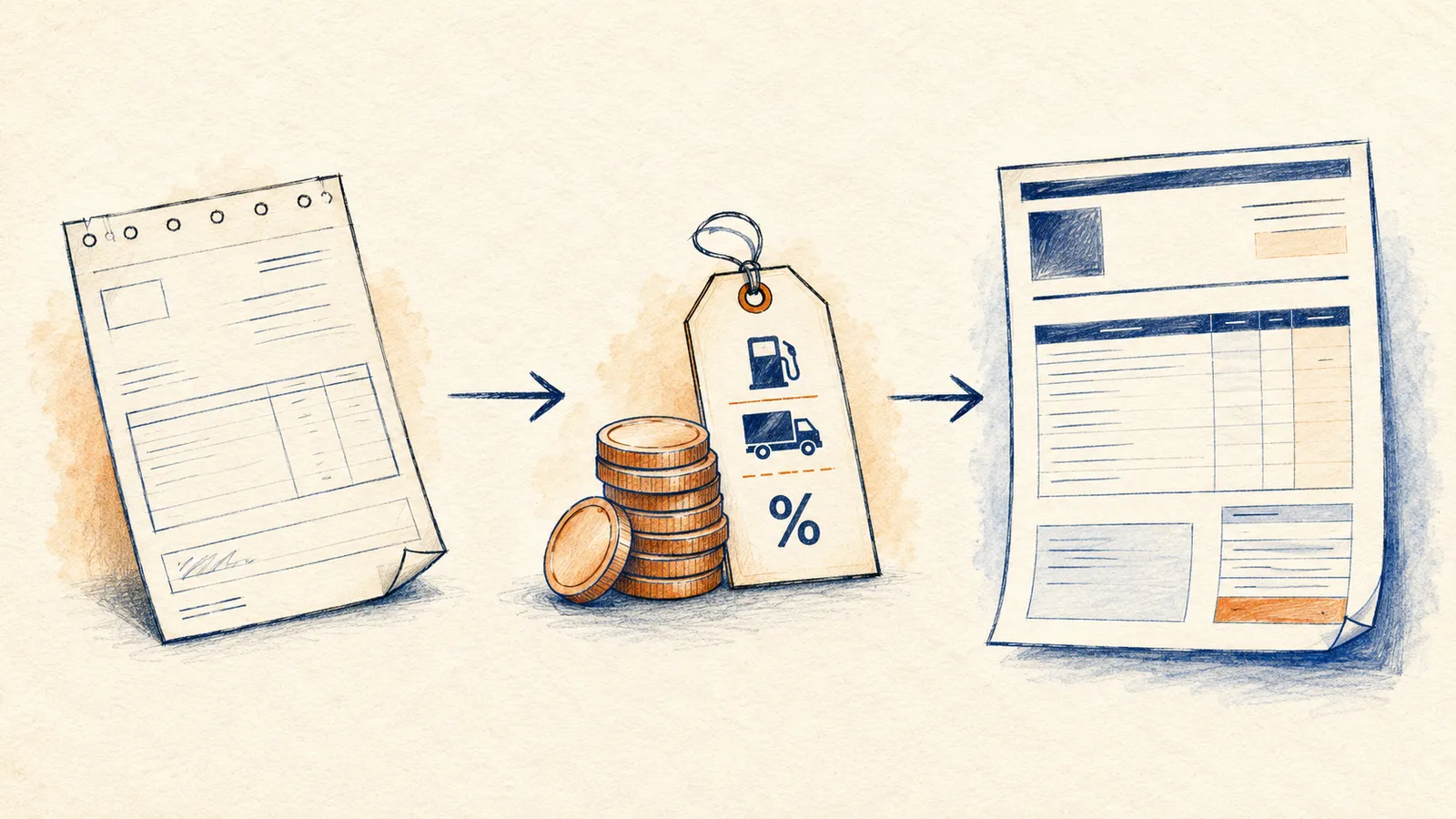
BOL to invoice is the path a load of fuel takes from the bill of lading you get at the terminal to the invoice your customer pays. It is the core of a fuel jobber's back office. On a 7,500-gallon transport load, every cent of error is $75. Type the same load twice and each one gets two chances to go wrong.
What a BOL is
A bill of lading, or BOL, is the document that records a fuel load. When a truck lifts fuel at the terminal, the BOL lists the gallons, the product, the date, the terminal, and the taxes on that load. Most BOLs show two gallon counts, gross and net, and knowing which one your supplier bills on and which one you invoice on matters on every load. The BOL is the proof of what you bought and the starting point for what you bill. For the bigger picture, see what is a fuel jobber and above the rack vs below the rack.
How a load becomes an invoice
The trip from BOL to invoice has a few steps:
- The truck lifts fuel at the rack, and the terminal issues a BOL.
- You record the load: gallons, product, price, freight, and tax.
- You match the load to a customer order or a delivery.
- You set the price with your markup and freight.
- You produce the invoice and send it.
- You track payment and post it to the books.
Every one of these steps is a place where a number can slip.
Where double entry creeps in
Double entry is when the same load gets typed more than once. It shows up like this:
- You enter the BOL in a spreadsheet for tax, then re-type it into QuickBooks for the invoice.
- You key the gallons into an inventory sheet, then again into the billing sheet.
- A dispatcher logs the delivery, and the office re-enters it for billing.
Each re-type costs time and adds a chance for a wrong gallon, a wrong price, or a missed tax. Across hundreds of loads a month, small slips add up to real money.
The cost of getting it wrong
A rough BOL to invoice flow leaks money in ways that are easy to miss:
- A wrong gallon count bills the customer short or long.
- A missed tax layer eats your margin or risks a penalty.
- A late invoice slows your cash.
- A mismatch between the BOL and the invoice makes settlements and audits harder.
The dollars are concrete. Re-key a rack price of $2.417 as $2.471 on a 7,500-gallon load and the invoice is off by $405. At the few cents per gallon a jobber typically keeps, that one transposed digit costs more than the load earned.
How to do it in one step
The goal is single entry: record the load once, and let it flow to the invoice, the tax report, and the books. Good fuel software does this by:
- Capturing the BOL one time, with gallons, product, and tax.
- Carrying that data straight to the customer invoice with your pricing built in.
- Posting to inventory, tax, and the books from the same record.
- Flagging a load that does not match an order, so you catch it early.
Many terminals now issue electronic BOLs, and aggregation services such as DTN Fuel Admin deliver them to your back office in one consistent format soon after the truck loads, so the load can import instead of being typed at all. FastDragon is built around single-entry BOL to invoice, so a load you receive turns into an invoice without a second keystroke.
Questions people ask
What is the difference between gross and net gallons?
Gross gallons are what the terminal meter measured at loading. Net gallons adjust that volume to 60 degrees Fahrenheit, since fuel expands when warm and shrinks when cold. States differ on which figure they tax, so the same load can carry different gallon counts on the tax report and the invoice.
What is an electronic BOL (eBOL)?
An eBOL is the load record sent from the terminal's automation system instead of a paper ticket, usually available within minutes of the lift. Formats vary by terminal and supplier, which is why jobbers use a normalizing feed or a software import rather than wiring up each terminal by hand.
How long should a jobber keep BOLs?
Fuel tax audits commonly reach back three to four years, and IFTA requires four years of records from the filing date. Keep every BOL at least that long and store it matched to its invoice, because an auditor will want to see both together.
What if the supplier invoice does not match the BOL?
Hold the payment and dispute it with the BOL number in hand. Price-file errors and wrong tax jurisdictions happen on the supplier side too, and the BOL is your evidence of the gallons and terms at lifting. A settlement check that compares every supplier invoice to its BOL catches this before money leaves.