
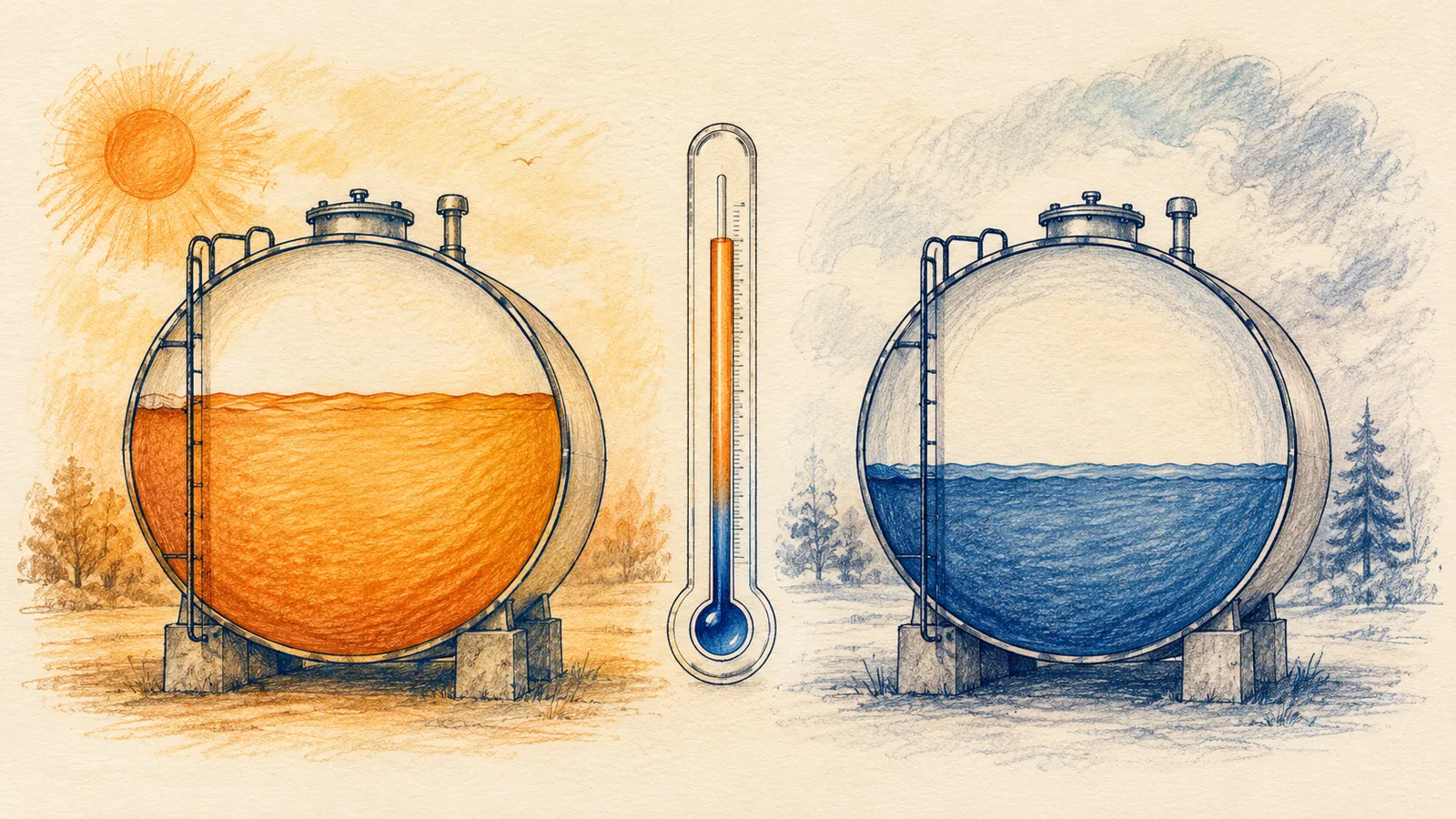
One quirk moves real money in the fuel business: the same load can be measured two ways, gross and net, and the two numbers are not equal. The whole difference comes down to temperature. Get the two bases mixed up and your margin reads wrong. This is how gross and net gallons work.
What they are
Gross gallons are the actual volume of fuel as measured. Net gallons are that volume corrected to a standard 60°F. Because fuel expands when warm and contracts when cool, the same physical load can show different gross and net figures. The gap is entirely about temperature, nothing else.
How big the swing is
Gasoline changes volume by roughly 1% for every 15°F. On an 8,500-gallon transport, that is about 85 gallons of difference between a load measured at 75°F and the same fuel corrected to 60°F. Diesel swings less, but it swings. The correction itself comes from standard volume correction factor (VCF) tables published by the American Petroleum Institute, so two terminals correcting the same load land on the same net figure.
Why it matters for margin
Which basis you buy and sell on affects your margin. Buy on net and sell on gross in a warm climate and the example load above hands you 85 gallons you never paid for; in a cold climate the same arithmetic runs against you, load after load. The danger is inconsistency: comparing a gross number to a net one makes margin look like something it is not. This is part of catching fuel shrinkage too.
Where the two figures live
On the bill of lading at the terminal, which records both, and then throughout billing, tax, and inventory. Because the BOL carries both, the back office has to apply the right one in each place, since a mix-up distorts cost, margin, and the tank reconciliation. It connects to rack pricing, where the basis is part of the deal.
How FastDragon helps
FastDragon Fuel Jobber carries both gross and net from the bill of lading and applies the correct basis to cost, margin, tax, and inventory, so you never accidentally compare a gross number to a net one and misread your margin.
Common questions
Should I buy fuel on gross or net gallons?
Many terminal suppliers invoice on net (temperature-corrected) gallons, while US retail pumps sell gross gallons with no correction. Buying net and selling gross works in your favor in warm climates, since warm fuel measures more gross gallons than you paid for, and against you in cold ones. Check your contract and your state rules: the basis is negotiable at the rack and fixed at the pump.
Why is 60°F the standard for net gallons?
The US petroleum industry standardized its measurements at a 60°F base decades ago, and API volume correction factor (VCF) tables convert any observed temperature back to it. A reading above 60°F gets a factor below one; below 60°F, a factor above one. Canada and most other countries use a 15°C base instead, which is why cross-border paperwork can show both.
Do fuel taxes use gross or net gallons?
It depends on the state. Some states require motor fuel tax reporting on gross gallons, others on net, and some accept either as long as you stay consistent. Your tax basis can differ from your invoice basis on the same load, which is one reason fuel systems carry both figures instead of converting once and throwing one away.
Does temperature correction happen at retail pumps?
Not in the United States: retail customers buy gross gallons at whatever temperature the fuel sits in the tank, with no correction at the dispenser. Underground storage keeps retail fuel temperature fairly stable, which mutes the effect at the pump. The bigger swings happen upstream, on transport loads measured at the terminal on hot or cold days.